



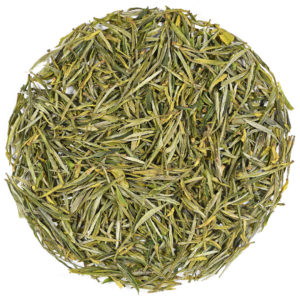
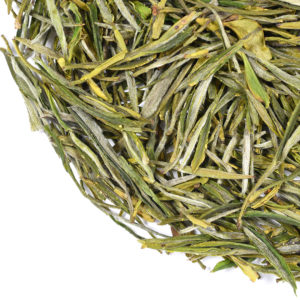
Wu Li Qing green tea has been a popular spring green tea since the Song dynasty. It has been manufactured and sold under various names throughout history, depending on who was growing and producing it, and occasionally who was drinking it. Wu Li Qing green tea is revered as being a very exquisite and refined tea. Wu Li Qing was originally manufactured in the southern portion of Anhui Province, in the area of what is today Huangshan City, and the earliest-known versions were produced from tea leaves plucked from wild tea bushes (as was most of the tea from this region, one of the most famous of the historic cultivated tea-growing areas in China). Eventually this sub-varietal was transplanted to at least several locations in Anhui Province, one of which is the Jiu Hua Shan, the origin of our exquisite Buddha’s Tea.
In our travels in Anhui Province we have been fortunate to have tasted this tea several times, but until very recently there was not enough current production of it for any of it to be able to be exported, and it was consumed entirely by wealthy Chinese and now the growing Chinese middle class.
Wu Li Qing green tea has an exquisite taste, and the flavor of this highly regarded tea is memorable. It is a subtle tea, very much in the style of green tea that is preferred by East Asians. The intensity of flavor is easily controlled by the steep time, so for those who prefer a lighter beverage, the ‘normal’ two-minute steep is appropriate. However, for those who are looking for a more robust cup, a four-minute steep will change the character considerably and the resulting steeped tea will be hearty and full bodied, almost oolong-like. There is just the slightest hint of chestnut, but mostly the distinctive flavor component is the rich, mouth-filling flavor that it has that is reminiscent of magnolia flowers. This delicate and yet present element will please even the most discriminating green tea drinker. Both the aromatic qualities and the inherent flavor are quite thirst-quenching.
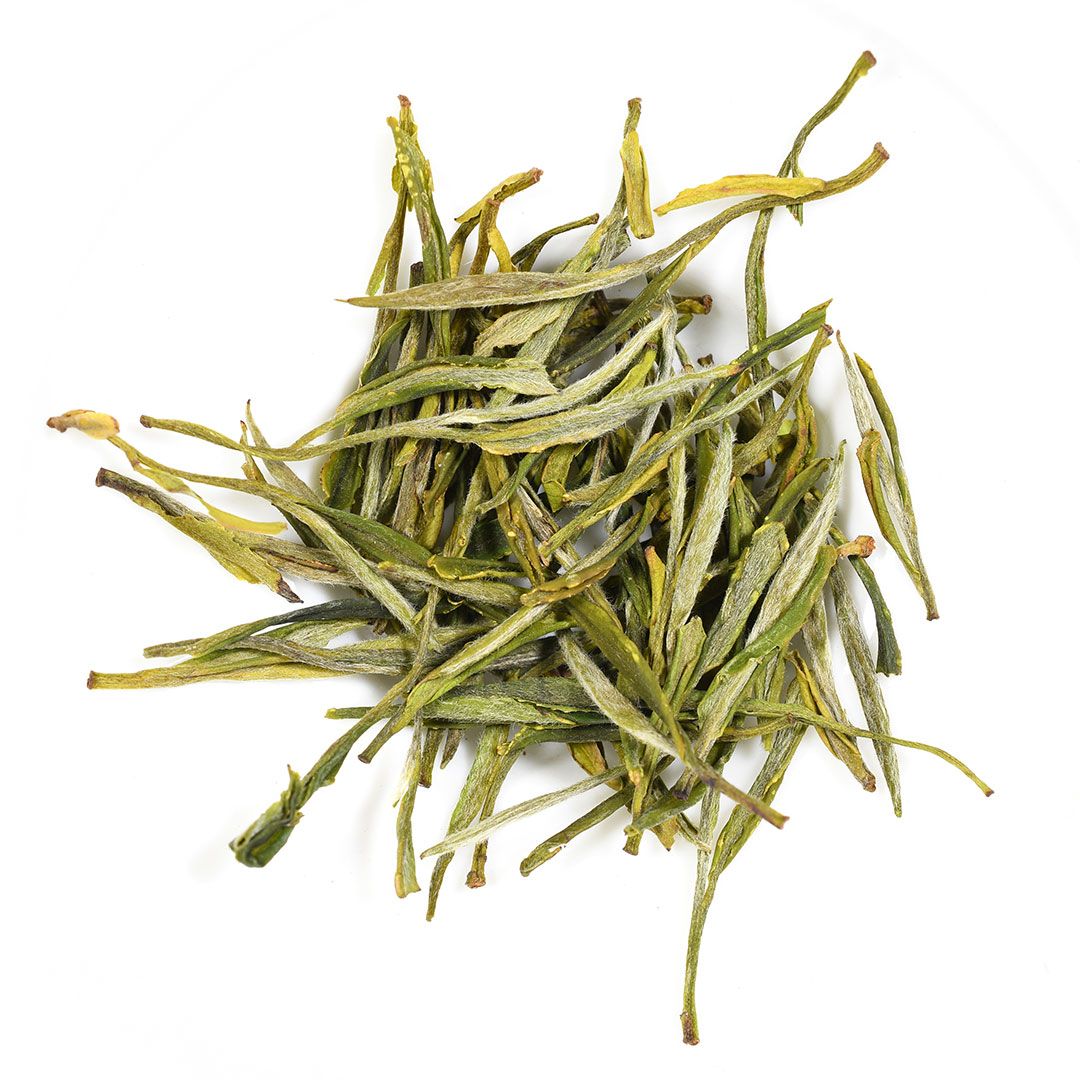
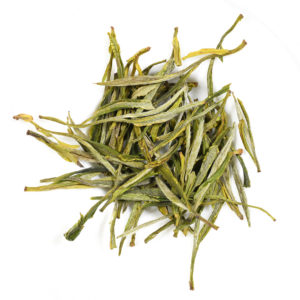
The ‘leaf’ consists of slender, whole buds, sometimes accompanied by a single ‘true’ leaf. As with several other long length Chinese green teas, these tea buds will sometimes be coached to stand upright in the cup, or will rise up and down in the steeping water, as though they are dancing.
Being from gardens located farther north than some of the Anhui Province tea gardens, this finished tea will store better than the early spring, PQM teas. Like the Buddha’s Tea, it will drink well through the autumn and the winter, even past the beginning of next spring’s harvest.
Well after the powerful British East Indies Company had established trade routes to the British Isles via Canton, when the Swedish East Indies Company also was shipping ceramics, silk and tea, although to Scandinavia primarily from Shanghai, one of the cargoes that the Swedes tended to carry was the different style of tea that was manufactured in Anhui Province, which was highly sought-after and therefore expensive. It often had the Swedish Royal Court as its final destination.
One such tea, Wu Li Qing green tea, was in high demand among the Swedish nobility. They had basically ‘discovered’ it, and had a virtual ‘lock’ on the supply chain of it due to their contacts in the mid-coast region of the mainland, and the high price that they were willing to pay for this glorious tea.
Ultimately, over time, Wu Li Qing green tea really became one of the many teas of legend, one rarely seen, much less tasted or available on the market. In the 1990’s, Zhan Luojiu a tea expert and professor at the Anhui Agricultural University had read about Wu Li Qing green tea and decided to try to revive the production of it in its most known setting of southern Anhui Province. After many false leads, he located what are assuredly some of the ‘original’ gardens of the wild tea bushes, and was able to propagate new plants from old ‘mother’ plants and start up a modest production of this famous tea. Today this modern harvest comes from both Shi Tai County and Jiu Hua Shan, both in Anhui Province. These two tea manufactures are virtually identical. Our 2021 offering happens to come from the Jiu Hua, one of our favorite tea locations in China, but we would source either, as they are so similar, and both from fantastically beautiful origin locations.
As is true for many Chinese green teas, researchers spend much time analyzing these historic plants. They have found that Wu Li Qing is high in minerals and vitamins, and also contains a large amount of selenium, which may rank it higher than some other green teas in terms of potentially preventing cancer. More research is needed, of course, but this is interesting in terms of taste and growing ease as well.
Tea Trekker’s 2021 spring harvest Wu Li Qing green tea is a very special tea, and we are very excited to be able to offer it this season.
 Seasonal Tea Explained