


Our Eastern Delight 2nd Flush tea from the early/middle part of the main harvest at Giddapahar Tea Estate this year is for those who prefer that their Darjeeling tea has a rich, mouth-filling, smooth-around-the-edges and ‘traditional’ china bush style. This style, in which the wither is short and the oxidation long, is often referred to as ‘muscatel’ in Darjeeling, and is clearly different than the green-ish style that is a result of a long wither and short oxidation. While the latter style has seemed so prevalent recently, we are seeing more of the traditional muscatel style now, especially in the manufacture of 2nd Flush teas, and we think this is great. The 2021 harvest was again perfect for this more traditional wither/oxidation balance due to the normal-to-slightly-late harvest and larger leaf particle size, (as the leaf was in 2019).
The dry leaf has this slightly large size due to the plentiful rains this spring. This china bush leaf has the classic 2nd Flush aroma in its dry leaf: pure, clean and straightforward. The considerable aroma that is contained in the leaf releases readily upon application of the steeping water, and will vary in intensity depending on the temperature of the hot water. Very pleasant and highly desirable aromatic qualities are released by the wet leaf during steeping. While the dry leaf has hints of melon, cacao, and dry wood bark (including just a tease of camphor) in the aroma, the wet leaf releases these aromatics in restrained abundance. Cacao and the classic aroma of a high quality china bush black tea are the primary elements of this enticing tea – in total, the oxidized smell that so distinctively identifies this traditional style of 2nd Flush wither and oxidation, whether from eastern China or from northern India.
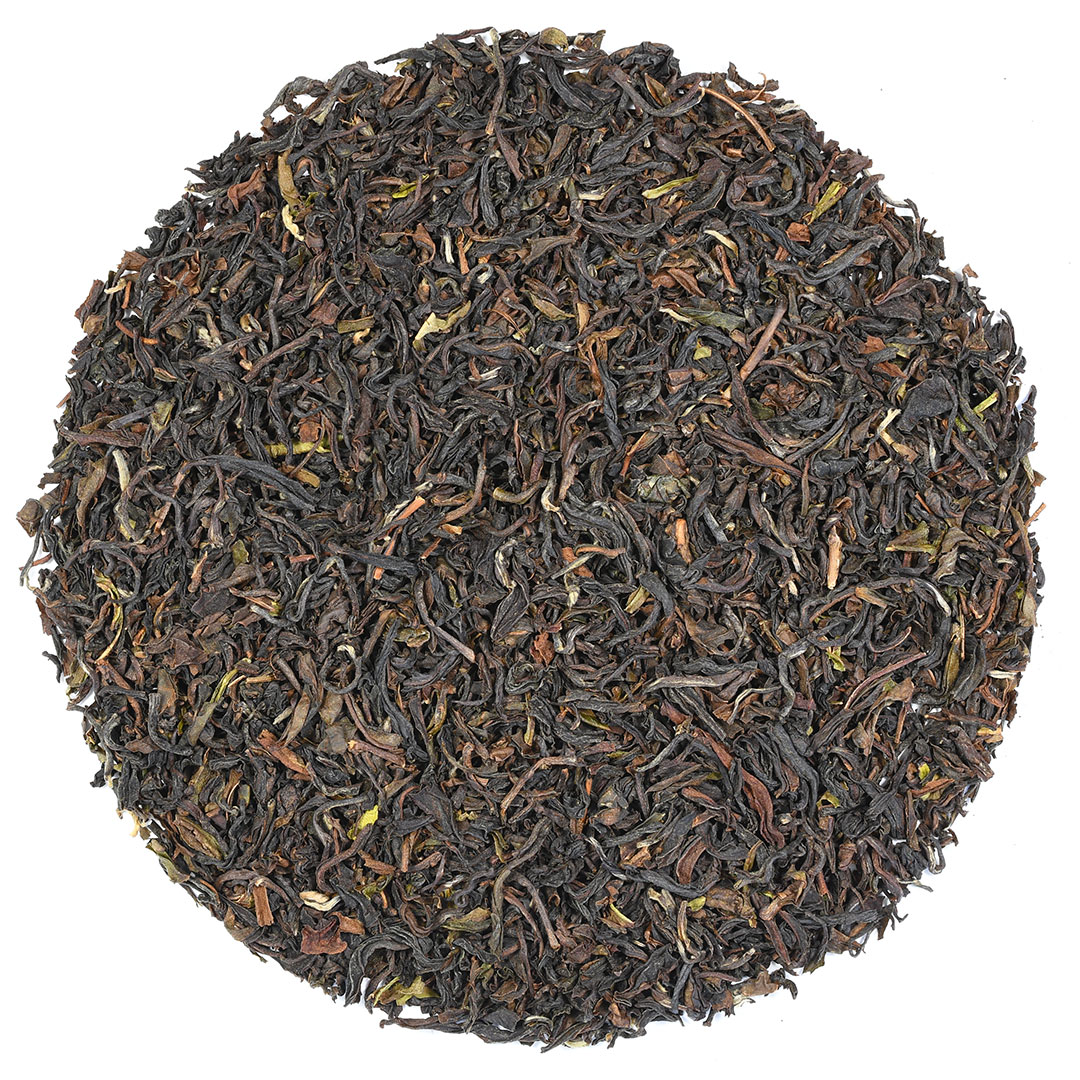
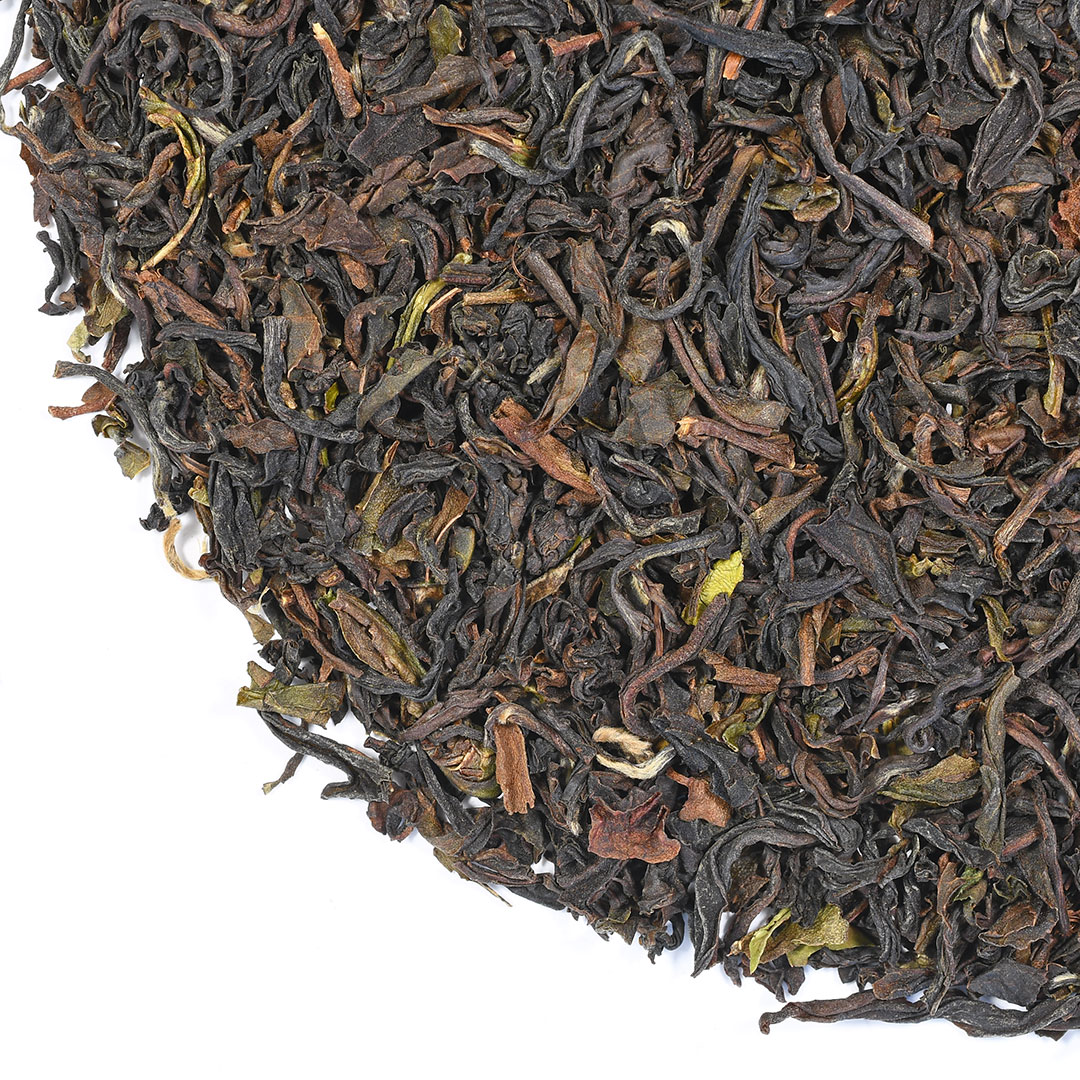
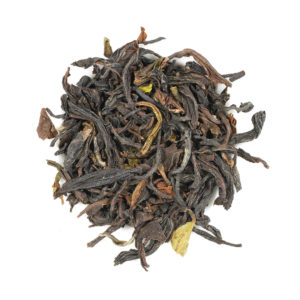
The leaf is classically beautiful, very dark in color, with not a trace of any modern, trendy, green, long-withered leaf. The dry leaf of Tea Trekker’s Giddapahar Tea Estate’s ‘Eastern Delight’ 2021 2nd Flush tea is traditional in both shape, size and color. The leaf is a mix of slender, mid-length leaf and well-twisted long leaf, and is quite even in its sorting. The leaf is a beautiful mottled cordovan brown in color, towards the dark end of the spectrum for a Darjeeling. The steeped leaf shows a variation of color and the open, large leaf is quite distinctive.
The base flavor of this Darjeeling, (and generally of the Giddapahar Tea Estate’s 2nd Flush teas) is that of a classic 2nd Flush Darjeeling. This taste could serve as the model for its genre. Lush, deeply-flavored, and without astringency, it possesses a significant raisin-y taste on top of its muscatel flavor. There is no biscuit influence but rather a complex blend of stone fruit and clean earth flavor components.
There are significant elements of stone fruit in its aroma, and the ever-so-slight aroma that one picks up from the earth when walking at a wood’s edge after a brief shower. We picked up a hint of cacao in the aroma as the tea cools. This is similar to the flavor that one receives from an Eastern China black, or a Yunnan black, and sometimes a large-leaf, darkly oxidized Nepal black. The aroma is in perfect proportion to the flavor, so they work in tandem to provide a wonderful, complete flavor package.
Layered on top of this traditional Darjeeling 2nd Flush flavor is the influence of the china bush taste, which offers the cacao, dark toast, and that touch of camphor that is so popular in some circles. This tea is so well-balanced and smooth that it could almost pass for an eastern China tea, but, in the final analysis, the core Darjeeling flavor keeps it firmly in the Darjeeling group. Very full-bodied, the soft, muscatel flavor is in perfect balance with the body and aroma throughout the drinking experience.
Showing a beautiful liquor color of deep claret-amber, this tea is a winner.
We are recommending a moderately short steep for this tea. I have been steeping it for about two and a half minutes. The leaf is large for a Darjeeling, so use a generous measure. We have been quite successful re-steeping the leaf, often for quite a long steeping time – even 4 minutes.
Giddapahar Tea Estate is located in the most prestigious heart of the Kurseong Valley. (Giddapahar is translated from Nepali to mean Eagles’ Cliff). Giddapahar Estate is owned by fourth generation tea growers Surendra Nath Singh and his brother, and is a relatively small area of 109 hectares. The gardens are poised at an average altitude of 4,800 feet and their orientation offers an incredible view of the Himalaya. The garden was first developed in 1881 and has been producing fine tea continuously.
Giddapahar is one of the few remaining tea estates with gardens that still produce tea from older plantings of China bush tea varietals. We feel that leaf from these mature tea bushes adds body and richness to the mouth-feel of a fine Darjeeling, so we always look for these ‘gems’ from the few gardens that still maintain their long-lived China bush stock.
 Protected Origin Status Granted to Darjeeling Tea